


What Is Ulthera?
Ulthera, or Ultherapy, is a technology for lifting and firming the facial skin and reducing wrinkles without surgery. It uses micro-focused ultrasound (MFU : Micro-focused Ultrasound) to deliver energy that generates heat beneath the skin at varying depths, lifting and firming the skin without surgery, and it is US-FDA cleared.
How Does Ulthera Work?
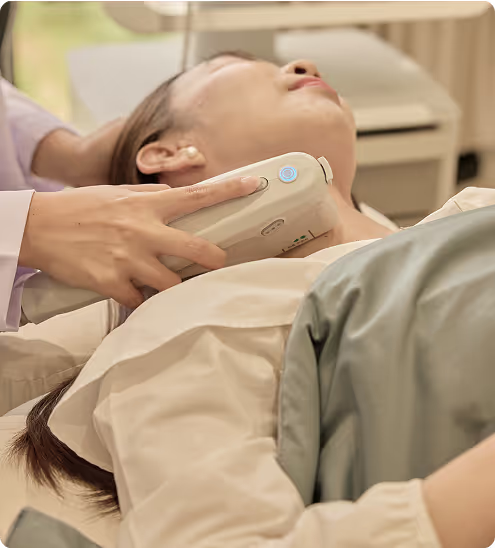
It works by sending micro-focused ultrasound (MFU : Micro-focused Ultrasound) into the skin at varying depths. This ultrasound energy converts into heat at 60-70°C, causing the tissue beneath the skin to contract and tighten immediately, while also continuously stimulating the production and remodeling of new collagen. This helps lift and firm sagging, wrinkled skin without surgery and without downtime, with 20% - 30% of the result visible immediately after treatment. It can be performed across the entire face, neck, and body.
Ulthera’s Main Treatment Depths
The transducers are divided into 3 main depths, each suited to different concerns and skin layers, as follows
- Depth of 4.5 mm, used on the SMAS layer (Superficial Musculo Aponeurotic System),
the muscle layer containing horizontal collagen. Energy reaches a depth of about 4.5 millimeters, the same skin
layer targeted in a surgical facelift, lifting and firming the skin by focusing on tissue contraction, which suits the cheeks, jowls, and neck.
(illustration)
- Depth of 3.0 mm, used on the subcutaneous fat layer (Dermis) to stimulate collagen and reduce sagging, with vertical collagen. Energy reaches a depth of about 3 millimeters, suited to the eye area and forehead, and it can also treat the SMAS layer in areas of the face where the skin is thin.
(illustration)
- Depth of 1.5 mm, used on the epidermis (Epidermis/dermis) to help firm and smooth the skin, minimize pores, and soften shallow wrinkles. Energy reaches a depth of about 1.5 millimeters, suited to wrinkles on the upper skin layers, the epidermis (Epidermis) and the dermis (Dermis).
(illustration)
What Skin Concerns Can Ulthera Address?
- Lifts and firms the face, defining the facial contours more clearly
- Smooths the skin by stimulating collagen production
- Softens wrinkles, lifts the nasolabial folds, and reduces under-eye hollows
- Lifts the brow tails and outer corners of the eyes, correcting drooping brows caused by sagging skin
- Helps the face look more youthful through deep-layer skin renewal
How Do Ulthera SPT and Ulthera prime Differ?
At present, ILLUM Clinic offers Ulthera prime, the latest model.
Ulthera SPT
Ulthera SPT is a technology that uses micro-focused ultrasound (MFU : Micro-focused Ultrasound) with energy that reaches deep into the SMAS layer, the same layer surgeons work on during a facelift. It comes with a screen that displays the skin layers in Real time, letting the physician see the skin layers during treatment and plan precise, targeted energy delivery.
Ulthera prime
Ulthera prime is the latest lifting and firming device, developed as an evolution of Ulthera SPT. It works on the same lifting and firming principle, with an upgraded display that performs better, more stable and gentle energy delivery into the SMAS layer, a processing system that is 20% faster, shorter treatment time, less discomfort, and the same excellent, lasting results.
A Comparison Table of Ulthera SPT and Ulthera prime
Ulthera SPT
1.5 mm transducer shallow skin layer
3.0 mm transducer subcutaneous fat layer
4.5 mm transducer SMAS muscle layer
Ulthera prime
1.5 mm transducer shallow skin layer
3.0 mm transducer subcutaneous fat layer
4.5 mm transducer SMAS muscle layer
Comparing Ulthera With Other Popular Skin-Lifting Devices
A comparison table of Ulthera and other skin-firming devices
Ulthera
1.5 mm transducer shallow skin layer
3.0 mm transducer subcutaneous fat layer
4.5 mm transducer SMAS muscle layer
Ulthera
1.5 mm transducer shallow skin layer
3.0 mm transducer subcutaneous fat layer
4.5 mm transducer SMAS muscle layer
Oligio
Exilis
- Transducer for the face, neck, and hands
- Transducer for the body
In Summary: Which Device Suits Whom? Which Should You Choose?
- Those with sagging skin and little fat who want results close to a surgical facelift, we recommend >> Ulthera
- Those with wrinkles and slight sagging, younger people who want to start caring for their skin early, we recommend >> Ultraformer III
- Those who want to reduce subcutaneous fat, renew the skin, and soften fine wrinkles, suited to those with fuller cheeks, we recommend >> Oligio
- Those who want to renew the skin and reduce subcutaneous fat with no pain and no numbing cream, we recommend >> Exilis
Who Is Suited to Ulthera Treatment?
- Those aged 25 and over who are concerned about sagging, loose skin across the face, drooping eyelids, drooping outer eye corners, undefined facial contours, fine lines on the face, sagging skin at the jowls and neck, or wrinkles on the décolletage
- Those with sagging skin who do not want a surgical facelift and have no time for recovery. Ulthera addresses these concerns well without changing the facial structure, allowing you to carry on with normal life
- Those whose cheeks are not very large or who have little accumulated fat and want more defined facial contours, a slimmer face, a clearer jawline, and reduced jowls or a double chin
- Those with limited time for skincare who want to renew the skin so it looks firm, plump, and smooth with minimized pores, because Ulthera stimulates collagen production down to the SMAS layer, and just 1 treatment per year gives clear, satisfying results
- Those who want firmer, tighter skin on the décolletage, upper arms, or abdomen with less sagging
Which Areas Can Ulthera Treat, and How Many Lines Should Be Used?
Ulthera can be performed on both the face and the body. The physician will give an initial assessment of the number of lines, since each treatment area uses a different number of lines depending on the concern, the patient’s skin condition,
and the size of that area, or on any area the patient is particularly concerned about.
The physician will assess each case individually.
Number of Lines for Ulthera Treatment
- Full face: approximately 500 - 700 lines (the standard is 700 lines)
- Full face and neck: approximately 700 - 1,000 lines
- Cheeks and jowls (contouring the face): approximately 300 - 500 lines
- Around the eyes (lifting the outer eye corners / brows): 100 - 200 lines
- Cheeks: 300 lines
- Jowls: 100 - 200 lines
(graphic illustration)
What Are the Pros and Cons of Ulthera Treatment?
Pros of Ulthera Treatment
- A highly safe treatment method and a technology recognized worldwide, US-FDA cleared, supported by more than 120 published scientific journal articles,
with more than 3 million Ulthera treatments performed in 80 countries worldwide - Lifts and firms the face without a surgical facelift, with no injections or medications,
making it highly safe - Stimulates collagen deep into the SMAS layer, leaving the skin smooth and plump and softening fine wrinkles
- No marks, no wounds, and no downtime; you can carry on with normal life after treatment
- About 20% - 30% of the result is visible immediately after treatment, 50% at 1 month,
and 100% at 3 months, with clear results seen from the very first treatment - A single treatment maintains results for more than 1 year, depending on your skin condition and aftercare
following treatment - It can be repeated every year to maintain results, with no long-term side effects
Cons of Ulthera Treatment
- There may still be some discomfort during treatment in certain areas, such as the jawline, where a tingling sensation can occur,
depending on each person’s skin sensitivity - After Ulthera treatment, some patients may experience redness, which resolves on its own
within 1 hour - Some patients may have slight swelling for about 1 week after treatment, depending on their skin condition
- If performed by an inexperienced provider, there is a risk of bruising, swelling, or skin burns
Is Ulthera Treatment Dangerous? Does It Have Side Effects?
Ulthera is a skin-lifting technology that is safe and holds safety certification
from the United States and Europe (US-FDA). It is also supported by more than 120 published papers, with more than 3 million treatments performed in more than 80 countries worldwide, and it is approved by Thailand’s Food and Drug Administration (Thai FDA). Patients can be confident that Ulthera is highly safe and precise. At ILLUM Clinic treatment is carried out by specialist physicians, and the Ulthera device has a real-time display that lets the physician see the skin layers before every energy pulse. Side effects are only minor and resolve on their own, such as swelling, redness, numbness, or bruising, but if performed by an inexperienced provider there is a risk of bruising, swelling, or skin burns, so treatment should only be done at a clinic with specialist physicians.
Preparing for Ulthera Treatment
Ulthera treatment requires no special preparation, as it is a non-surgical procedure.
Patients can book a consultation with a specialist physician beforehand. You should share information about any underlying conditions, surgical history, or any previous facial procedures, so the physician can assess the patient
and understand what facial concerns you have, or which areas you would like to emphasize, and plan the facial reshaping together to decide whether Ulthera is suitable. If Ulthera is suitable, the appropriate number of lines for treatment will be advised,
and finally, if the patient has no health or other concerns, treatment can proceed right away.
The Ulthera Treatment Procedure
The Ulthera treatment procedure takes approximately 30-60 minutes, depending on the number of lines used
and not including the time for applying numbing cream. The steps are as follows:
- The physician examines the skin condition, assesses the degree of sagging, and plans the facial reshaping together with you,
along with the number of lines suited to your face - The face is cleansed, before-treatment photos are taken, and numbing cream is applied for about 30 - 45 minutes to reduce sensation during treatment; once the time is up, the numbing cream is wiped off to begin the Ulthera treatment
- The physician uses the Ulthera device to deliver energy to the assessed areas, adjusting
the transducer depth and number of lines according to the skin condition, to lift and firm the patient’s skin precisely - After treatment, the face is cleansed, moisturizer and sunscreen are applied for the patient, and after-treatment photos are taken for comparison
- Once finished, the patient can go home immediately with no downtime and can carry on with normal life; there may be slight swelling, which resolves on its own within 2-3 days
How to Care for Yourself After Ulthera Treatment
- You can carry on with your normal daily life
- Wear makeup and apply moisturizer and sunscreen with SPF 50 or higher
- Avoid squeezing, pressing, or massaging the face hard
- Avoid scrubs or harsh treatments for about 3-5 days
- Avoid high heat, such as saunas, facial steaming, steam rooms, or strong direct sun, for 1-2 days
- Refrain from heat-based lasers that reach the deep skin layers, such as RF, for about 1 month
When Will You See Ulthera Results? How Many Days Does Facial Swelling Last After Treatment?
When will you see results after Ulthera treatment?
- About 20% - 30% of the result is visible immediately after treatment
- The skin becomes increasingly lifted and firm over 2-3 months
- Results last for 1 year, depending on skincare and individual factors
How many days does facial swelling last after Ulthera treatment?
After Ulthera treatment, some people may have slight swelling or a feeling of tightness in the treated
area. This gradually improves and resolves within 2-3 days. If the patient feels a deep tightness when pressing, this sensation may last about 1-2 weeks, which is normal from collagen stimulation.
A 5-Point Checklist: Where to Go? Before Deciding on Ulthera
Choosing a good clinic for Ulthera gives clear, safe results. Here are 5 points to check before you decide.
- A trustworthy, licensed clinic
Choose a clinic or medical facility licensed by the Ministry of Public Health, with a clearly displayed license number and reviews from real customers, so you can be confident it is a safe place and not an unlicensed clinic.
- Specialist, experienced physicians
Choose a clinic with genuine specialist physicians who have experience performing Ulthera on many cases, which helps them assess your skin concerns and plan the right number of lines.
- A genuine Ulthera device that meets safety standards
Verify the device is genuine by checking the list of clinics on the website www.merzaesthetics.co.th
- Reasonable pricing
Ulthera is a high-end device. If you come across prices that are unrealistically cheap or offers of unlimited lines,
be cautious, as it may be a counterfeit device or one with a similar-sounding name, such as Ultra X or Ultralift, which may produce no results and may cause side effects.
- Reviews from patients who have actually been treated
Look at before-and-after photo reviews of patients across a range of ages, which helps you be confident that the results are achievable and that the clinic is trustworthy.
How to Verify a Genuine Ulthera Device
- A gold Merz check sticker on the device that, when scanned, displays the clinic’s name
- A Certificate of Authenticity
that must clearly state the clinic’s name, along with a serial number matching the one on the back of the device - Symbols and stickers at the clinic
A genuine clinic displays a Certificate sticker on the clinic’s front glass and has an Authenticity diamond shield
as well as an Ultherapy Prime pin to confirm authenticity - Check the list of clinics on the official Merz website at > www.merzaesthetics.co.th
Ulthera Reviews From Real Users, With Before-and-After Comparison Photos
(lots of before-and-after photos)
Promotion Ulthera Prime
(graphic)
Frequently Asked Questions
Can Ulthera Be Combined With Other Procedures?
Yes, it can be combined with other procedures to enhance and sharpen the results, such as Oligio, Botox, Filler, Vitaran, and other skin treatments.
Is Ulthera a Good Choice?
Ulthera treatment is an option for those looking for the best way to lift and firm sagging skin
and make it tighter. Today Ulthera is an increasingly popular lifting technology because it addresses many concerns at once: slimming the face, lifting the brows, lifting the outer eye corners, defining the facial contours, and softening wrinkles after just 1 treatment, with results lasting up to 1 year.
Does Ulthera Hurt?
During treatment there may still be some discomfort in certain areas, such as the jawline, where a tingling sensation can occur, depending on each person’s skin
sensitivity. However, numbing cream can be applied beforehand to reduce sensation, and newer devices like Ulthera Prime
are less painful than earlier models.
Is Ulthera Safe?
Ulthera is a skin-lifting technology whose lifting performance is guaranteed safe to U.S.FDA standards and approved by Thailand’s Food and Drug Administration (Thai FDA). It is supported by more than 120 published scientific journal articles, with more than 3 million Ulthera treatments performed
in 80 countries worldwide.
What Age Is Ulthera Suitable For?
It suits those aged 25 and over, especially people starting to see sagging skin and fine lines or who want to lift and firm the facial contours and neck, as well as the 30 - 50+ age group whose concerns are becoming more pronounced but who do not want a surgical facelift.
How Many Lines Is Best for Ulthera?
For Ulthera, the physician assesses the number of lines based on your concerns and the areas you want lifted and firmed.
Generally it starts at 300 lines.
How Many Months Until Ulthera Shows Results?
After Ulthera treatment, about 20% - 30% of the result is visible immediately, as the skin layers contract from the heat
focused beneath the skin. The result then gradually improves as new collagen forms, with the skin becoming 50% firmer at 1 month, and after 3 months the result becomes clearer at 100%.
In Summary: Is Ulthera Worth It? Is It Really Good?
Ulthera is a skin-lifting technology using micro-focused ultrasound (Micro focus-ultrasound:MFU), delivering energy deep into the SMAS layer, with a screen that shows the skin layers in Real time, without surgery, without downtime, and safely.
Ulthera can lift and firm the skin on the face, neck, and body.
The results of Ulthera treatment show an immediate change after the procedure and gradually become clearer over 3 months, lasting 1 year, depending on each person’s skin condition and aftercare.
For anyone interested in or considering Ulthera treatment, we recommend reviewing the information above, considering the clinic’s readiness, the physician’s experience, whether the device and equipment used are genuine and up to standard, and whether the price is neither too cheap nor too expensive.
ILLUM–CURATED TREATMENTS

Pleonchit road, Lumpini,
Pathumwan, Bangkok 10330,